Clean Energy Commissary
A planned support ecosystem that would bring shared kitchen space, cold storage, training, business services, and clean energy together for veteran mobile food vendors.
Proposed Infrastructure
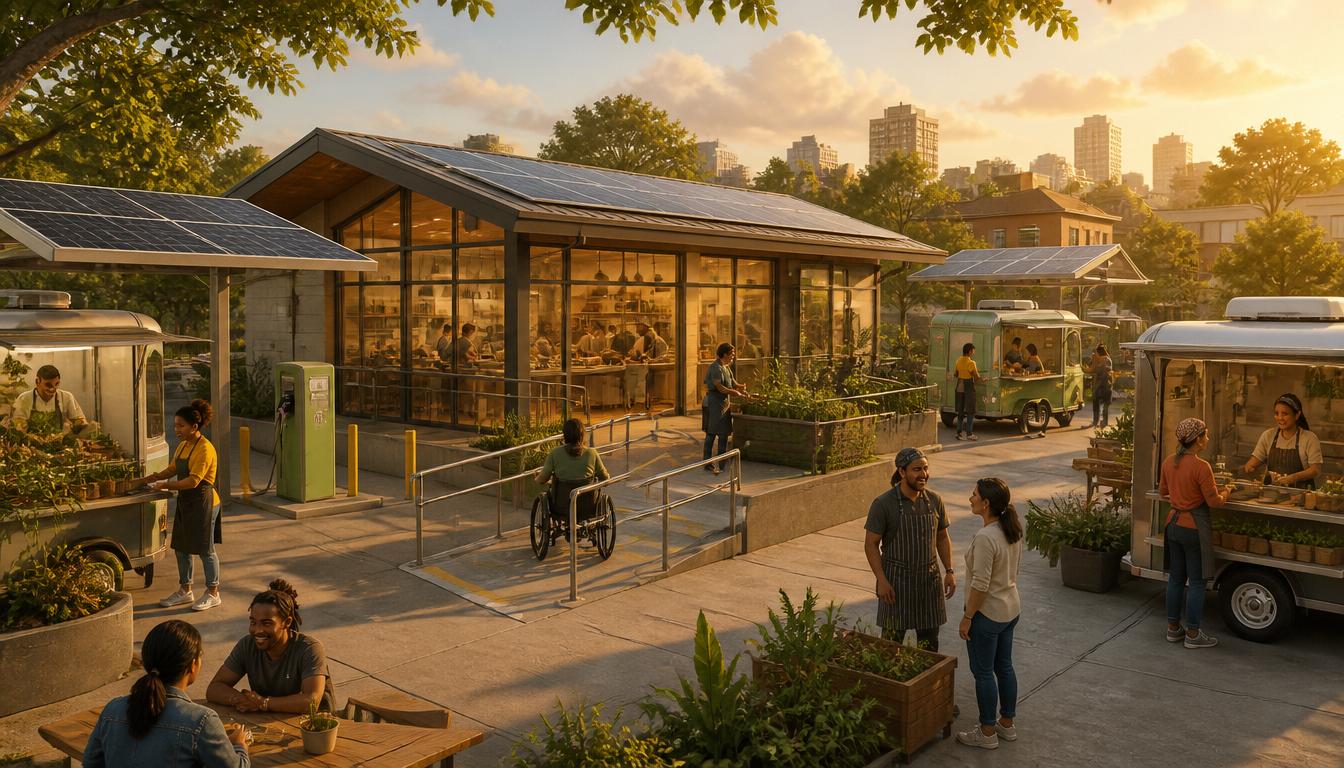
What a Clean Energy Commissary Could Provide
This is a long-term concept, not an active facility. If realized, the commissary would be designed to reduce the daily operational burdens mobile food vendors often face.
Shared commercial kitchen
Licensed prep stations where multiple vendors can prepare food safely and legally under one roof.
Food-preparation stations
Dedicated, adaptable workstations sized for carts and small-truck operations.
Refrigerated and cold storage
Walk-in coolers, freezers, and dry storage that help vendors meet health-code requirements.
Training facilities
Classroom and hands-on space for food safety, business operations, and adaptive equipment use.
Business-support services
Shared access to bookkeeping, licensing, marketing, and compliance mentorship.
Resource center
A staffed library of permitting guides, financing information, and veteran-service referrals.
Veteran community workspace
A gathering place for peer mentorship, veteran networking, and cooperative problem solving.
Renewable-energy infrastructure
Solar generation, battery storage, and efficient systems designed to lower long-term utility costs.
Potential EV food-truck charging
Planned electric-vehicle charging to support cleaner, quieter mobile food operations.
Section 1
The Operational Problem
Mobile food entrepreneurs in New York City routinely navigate a fragmented support landscape. Access to affordable, compliant infrastructure can be one of the hardest parts of the business.
Finding a licensed commercial kitchen, maintaining cold storage, sourcing equipment, and keeping up with health and business regulations can require significant time, money, and connections.
For disabled veterans, these barriers can be even larger. Facilities may not be accessible, support services may be scattered across agencies, and the energy and maintenance costs of running a mobile food business can be unpredictable.
Streetwise Start believes that a single, intentionally designed hub could help reduce these friction points—but that hub does not exist yet.
Hard-to-find kitchen space
Affordable, licensed commissary space is limited and often not designed for mobile vendors.
Storage and refrigeration
Reliable cold storage is critical for food safety and can be expensive or far from vending locations.
Charging and maintenance
Electric and low-emission vehicles need charging infrastructure that is not yet widely available.
Fragmented support
Training, mentorship, and business services are often located in different places and use different systems.
Section 2
The Proposed Commissary Model
The vision is a shared facility where infrastructure, education, and business support converge in one accessible, veteran-centered environment.
One shared facility
A single location would house kitchens, storage, training rooms, and business-support services.
Built for veterans
Every design decision would be informed by disabled veterans and the real requirements of mobile vending.
Cleaner operations
Renewable energy, efficient systems, and EV charging would lower emissions and long-term operating costs.
A vision, not a facility
The commissary model is currently in early planning. No physical facility is under construction, and no locations, partners, or opening dates have been confirmed.
Section 3
Accessibility by Design
The facility would be planned around the needs of operators with diverse mobility, sensory, and physical requirements.
Accessibility would be integrated from the earliest planning stages, not added as an afterthought. Input from disabled veterans and accessibility consultants would shape layouts, equipment choices, signage, and workflows.
The goal is a space where veterans with a wide range of abilities can prepare food, store inventory, attend training, and connect with peers with dignity and independence.
Accessibility planning would follow ADA, WCAG, and universal-design principles, with ongoing review by people with lived experience.
Step-free access
Ramped entries, wide corridors, and roll-under prep sinks.
Adjustable-height stations
Work surfaces that can be raised or lowered for wheelchair users and seated operators.
Sensory accommodations
Quiet zones, adjustable lighting, and clear signage for operators with sensory disabilities.
Accessible restrooms and lockers
Amenities designed for a wide range of mobility and support needs.
Clear wayfinding
Large-print, high-contrast, and tactile signage throughout the facility.
Accessible parking and loading
Designated accessible bays and close proximity to prep and storage areas.
Section 4
Clean-Energy Infrastructure
The commissary would aim to combine energy resilience with lower operating costs and a smaller environmental footprint.
Solar generation
On-site photovoltaic arrays sized to offset kitchen, storage, and charging loads.
Battery storage
Resilient energy storage to keep operations running during grid interruptions.
Efficient refrigeration
Energy-efficient coolers and freezers that reduce electricity demand and operating costs.
EV charging infrastructure
Charging stations for electric carts and trucks, supporting lower-emission mobile vending.
Waste reduction and composting
Food-waste diversion, composting, and recycling programs to support circular operations.
Stormwater and green space
Planters, rain gardens, and shaded outdoor areas that improve the neighborhood environment.
Solar
On-site generation
Battery
Resilient storage
EV Ready
Charging infrastructure
Specific technology choices, capacity, and vendors would be determined during feasibility and engineering studies. The descriptions above are aspirational, not final specifications.
Section 5
Potential Veteran Benefits
If the commissary is realized, it could offer meaningful advantages to veteran operators. These are potential benefits, not guaranteed outcomes.
- Reduced operational friction by co-locating prep, storage, training, and support services.
- Coordinated resources that connect vendors with mentors, funding information, and business tools.
- Accessible facilities designed with input from disabled veteran operators.
- Peer community of veteran entrepreneurs who share knowledge and encouragement.
- Training access that supports food safety, business planning, and adaptive operations.
- Potentially lower infrastructure costs through shared equipment and renewable energy.
- Greater business continuity through reliable cold storage and backup power.
Section 6
Development Status
This initiative is a long-term goal. The work completed to date is planning, research, and community outreach—not construction or operations.
Current work
- Concept development and vision documentation
- Community listening sessions with veterans and operators
- Research on accessibility standards and commissary operations
- Preliminary partnership outreach
Future goals
- Feasibility study and site selection
- Capital planning and funding strategy
- Design and permitting
- Pilot programs and phased launch
No facility is currently operational.
No construction, site lease, or confirmed funding has been finalized. This page describes a future vision and planning effort only.
Section 7
Partner and Sponsor Opportunities
A future commissary would require collaboration across many sectors. Below are the partnership pathways Streetwise Start is exploring.
Municipalities
City agencies that can provide land-use support, permits, and connections to workforce programs.
Property owners
Owners of underutilized sites who could host a commissary or charging hub.
Food-service organizations
Kitchen designers, equipment suppliers, and operators with specialized commissary expertise.
Clean-energy companies
Solar installers, battery vendors, EV charging providers, and efficiency consultants.
Veteran organizations
Veteran-service organizations and advocacy groups that can help reach qualified operators.
Workforce-development organizations
Training partners that can co-develop curricula and placement pathways.
Academic institutions
Universities and research centers that can evaluate outcomes and support innovation.
Funders and sponsors
Foundations, impact investors, and corporate sponsors that can provide early capital.
Interested in supporting this vision?
Streetwise Start is seeking advisors, partners, and sponsors who can help shape the clean-energy commissary concept into a real resource for veteran entrepreneurs.
Section 8
Accessible Food-Truck Ecosystem
A long-term concept for modular, clean-energy mobile food-vending vehicles that could be adapted for different businesses and disabled veteran operators.
Streetwise Start is exploring a future vehicle ecosystem built on adaptable, low-emission platforms. These platforms would not be one-size-fits-all trucks; they would be modular concepts that could be configured for different menus, mobility needs, and business models.
The goal is to reduce the physical, technical, and financial barriers that make traditional food trucks difficult for some disabled veterans to operate. Every design element would be considered through an accessibility lens from the start.
The vehicle platforms, conversion designs, assistive technologies, robotic systems, advertising programs, and analytics services presented here are conceptual. They remain subject to engineering, accessibility, legal, privacy, operational, regulatory, and financial validation.
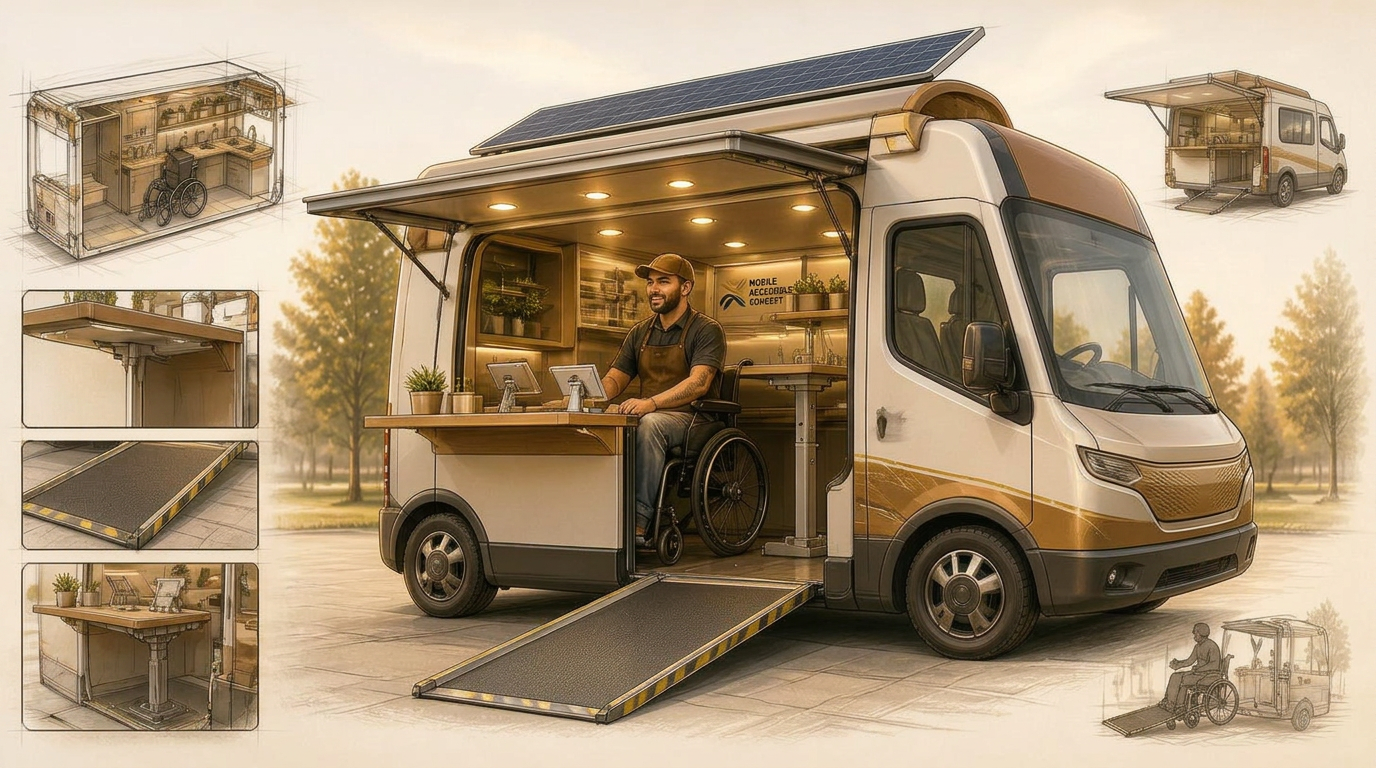
Conceptual Illustration
Operator-Centered Design
Potential Accessibility Concepts
These concepts are ideas, not installed features. They would need to be refined with engineers, accessibility specialists, and disabled veteran operators.
Accessible operator workstations
Workspaces designed for seated, standing, or wheelchair-based operation with clear reach ranges.
Lowered service counters
Counter heights that allow a wheelchair user to serve customers and handle transactions face-to-face.
Accessible entry systems
Ramps, lifts, or low-threshold entries so operators can enter and exit the vehicle independently.
Voice-assisted controls
Hands-free control of equipment, lighting, and ordering systems where voice interaction is practical.
Adjustable workspaces
Height-adjustable surfaces and fixtures that adapt to different operators and tasks.
Enhanced lighting
Task lighting and high-contrast controls to support low-vision operators and improve safety.
Improved safety systems
Non-slip flooring, clear egress paths, emergency controls, and fire-suppression suited for compact spaces.
Remote monitoring
Sensors and alerts that could track equipment health, energy levels, and safety conditions remotely.
Accessible storage
Reachable shelving, pull-out compartments, and secure storage for supplies and inventory.
Accessible food-preparation areas
Prep layouts with knee clearance, lever-handled fixtures, and clear maneuvering room.
Assistive technologies
Mounting points, switch controls, and compatibility with personal assistive devices.
Potential robotic assistance
Conceptual robotic aids that could reduce repetitive lifting or movement demands for some operators.
Flexible Business Models
Potential Business Configurations
A modular platform could allow operators to choose a concept that fits their skills, market, and community goals.
Coffee and beverages
A compact espresso, tea, or cold-beverage setup for high-traffic commuter and event locations.
Ice cream and desserts
A frozen-treat or bakery-focused configuration with cold-storage and display design.
Barbecue and grilling
Ventilated, safe cooking equipment for smoked meats, grilled items, and hot prepared foods.
Specialty foods
Ethnic cuisines, comfort foods, and niche menus that reflect the operator's background and community.
Healthy-food concepts
Fresh salads, grain bowls, smoothies, and nutritionally focused offerings.
Community feeding
Programs that provide meals in underserved neighborhoods, senior centers, or veteran gatherings.
Emergency and disaster-response support
Mobile feeding capacity that could support relief efforts during emergencies or planned events.
Sustainable Funding
Potential Revenue Channels
If the ecosystem were realized, several revenue streams could help make it financially viable and mission-aligned.
Food and beverage sales
Direct sales to customers at vending locations, events, and private bookings.
Ethically managed digital advertising
Carefully screened, non-intrusive sponsorship messaging displayed on vehicle surfaces or digital menus.
Sponsorships
Mission-aligned support from organizations that want to fund accessible veteran entrepreneurship.
Privacy-compliant aggregate operational insights
Anonymized, opt-in operational data that could help improve routes, menus, and vendor support.
Conceptual only
No vehicle platforms, conversions, assistive technologies, robotic systems, advertising programs, or analytics services are currently available or under construction. All descriptions, revenue projections, and business models are preliminary and remain subject to engineering, accessibility, legal, privacy, operational, regulatory, and financial validation. No manufacturer, robotics company, energy company, or technology provider is endorsed or implied as a partner.
Ready to explore what is available today?
While the commissary is a future vision, Streetwise Start already offers resources, guidance, and a community for veterans beginning the mobile food-vending journey.